
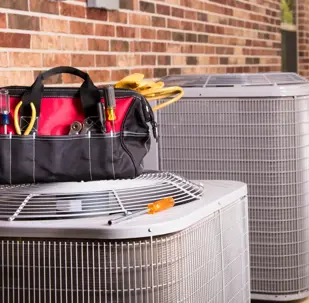
If your roof has a gas-electric package unit, you’ve got heating and cooling in one cabinet. Below we’ll explain, in plain language, what the parts do, how a safe start-up sequence works, why ultra-low NOx models behave a little differently, and the most common issues we’ve fixed across Fresno County and the Central Valley.
Meet the main components (what each part does)
- Gas valve – Opens to let fuel (natural gas or propane) flow to the burners.
- Burners & heat exchanger – Burners heat the metal heat exchanger. Indoor air passes over the outside of that metal and picks up heat (the flame never mixes with your breathing air).
- Inducer motor – A small fan that pulls combustion gases through the heat exchanger and out the vent. Ultra-low NOx units often use variable-speed inducers that ramp up or down on command from the control board.
- Vent – Carries combustion products safely outdoors.
- Blower motor – Pushes warm air through your ducts to the rooms.
- Ignition system – Either a hot-surface igniter or spark lights the burners (no standing pilot on modern units).
- Flame sensor – Proves that flame is actually present; if it doesn’t “see” flame, gas shuts off.
- Control/ignition board (PCB) – The “traffic cop” that runs the sequence, checks safeties, times the blower on/off, and stages heat.
- Safety switches –
- Pressure switch: Confirms the inducer is moving air and the vent path is clear before lighting.
- High-limit switch: Opens if the heat exchanger gets too hot (protects equipment).
- Rollout switch: Sits near the burners; trips if flame rolls out of the firebox.
- Other temperature, rollout, and door switches depending on model.
A normal heat start-up (the simple play-by-play)
- Thermostat calls for heat.
- Inducer starts and proves draft (pressure switch closes).
- Board runs a quick safety check (limits/rollouts).
- Ignition: hot-surface igniter glows or spark fires.
- Gas valve opens → burners light.
- Flame sensor proves flame (tiny DC signal back to board).
- After a short delay, the blower starts to move warm air.
- You’ll see a temperature rise of about 30–60°F from return to supply when gas pressure and airflow are correct.
- When the thermostat is satisfied, gas turns off; the blower runs briefly to pull extra heat out of the exchanger, then stops.
Ultra-low NOx furnaces follow the same steps but with tighter control of combustion and fan speeds to reduce emissions (South Coast AQMD Rule 1111 is the benchmark standard in CA). Those tighter tolerances are great for clean air, but they expect proper duct sizing, filters, and gas pressure to stay happy. AQMD+1
Real issues we see—and what they usually mean
- Blower runs constantly even with heat “off”
- Often a tripped high-limit or rollout (unit overheated), a stuck fan relay, miswired thermostat, or a bad control board. We cool, reset, fix airflow (dirty filter/undersized return), and test the safeties.
- Tries to light several times, then locks out
- Common causes: dirty flame sensor, weak hot-surface igniter, low gas flow, plugged burner orifice, or sticky gas valve. We clean sensors, verify micro-amps, test igniter resistance, clock gas, and check manifold pressure.
- Short cycles on/off
- Safeties are doing their job. Ultra-low NOx units are more sensitive to high static pressure (undersized/blocked ducts, closed returns), dirty filters, or low airflow. We measure static with a manometer and correct the airflow path. California guidance generally targets about 0.5–0.6 in. w.c. across the fan for residential designs. California Energy Commission
- Blower won’t run
- Failed ECM/PSC motor, bad run capacitor (PSC), failed board output, or no power at the disconnect. We test voltage and amp draw and compare to nameplate.
- Carbon monoxide (CO) alarms
- Stop, ventilate, and call us immediately. We perform a visual inspection and test with a certified combustion analyzer to ensure the heat exchanger isn’t compromised and the venting is correct. Each year in the U.S., hundreds of people die from accidental, non-fire CO exposure, which is why working CO alarms and professional testing matter. CDC+1
- Portable generators alone account for ~100 CO deaths per year on average—another reason to keep them outdoors and far from buildings. U.S. Consumer Product Safety Commission
Why airflow and gas pressure matter so much
- Airflow (static pressure): Think of static pressure as the back-pressure your blower fights. High static = noisy vents, hot heat exchangers, high amps, and early failures. We measure return + supply static and fix root causes (filter area, crushed/kinked ducts, undersized returns). johncipollone.com
- Gas pressure: We set inlet and manifold pressures to the manufacturer spec during commissioning. Wrong pressure can cause poor ignition, sooting, high CO, nuisance limits, and heat exchanger stress.
Quick glossary (no jargon, just useful)
- Ultra-low NOx furnace: Special burner/controls that cut nitrogen-oxide emissions. Great for air quality; expects clean filters, correct duct sizing, and proper gas pressure to avoid nuisance trips. California Air Resources Board
- Temperature rise: Supply air temp minus return air temp in heat mode (target range printed on the unit’s label—often 30–60°F).
- Static pressure: The system’s “blood pressure.” We aim to keep most residential systems near ≤0.5 in. w.c. total external static for comfort and equipment life. California Energy Commission
- High-limit / rollout / pressure switch: Automatic safety devices that shut things down if the unit overheats, flame misbehaves, or venting isn’t right. North NJ HVAC
How we diagnose (what you’ll see in our reports)
- Electrical readings: Voltage and amp draw on the blower and inducer so we catch stressed motors early.
- Combustion/venting: CO and O₂ with an analyzer; verify draft and vent integrity.
- Safeties & sequence: We step through the entire start-up and document every switch status.
- Airflow: Static pressure and filter/return sizing; note any duct issues.
- Photos + plain-English notes in your CRM report, with flat-rate repair options and (if needed) financing.
When a repair vs. a replacement makes sense
We’re repair-first. If the exchanger is intact and parts are available, we’ll lay out fixes to keep you running safely. If replacement is smarter (cracked exchangers, repeated lockouts, or an upgrade to higher efficiency), we’ll show clear options and costs—no pressure.
Bottom line
A gas-electric package unit is simple in concept but serious about safety. When airflow, gas pressure, and safeties are right, it runs quietly, efficiently, and safely for years. If yours is cycling, humming, or keeping the blower on when it shouldn’t, those are solvable clues—and we’ve solved them across thousands of service calls in the Valley.
Want us to check yours? We’ll test static pressure, temperature rise, safeties, gas settings, and CO—and walk you through the results in everyday language.
Caledonian Mechanical, Inc. — Heating, Air & Refrigeration
Serving Fresno County & the Central Valley with safe installs, careful diagnostics, and maintenance that actually pays off.